One priority I have always had is that Miss Devlin, who is playing our psycho mother, must look strange or abnormal as that's the type of character she is playing. At the same time, this can't be too obvious from the beginning. Obviously the picture I've shown is a more dramatic picture of what she will look like as it's too much for our film, but the make up will be dark and heavy showing harsh features on her face as that is quite stereotypical for a 'bad person' to have in a horror film. The way we'll make her look will still be within the boundaries of 'normal', we don't want the look to go over the top and look ridiculous, but there will be harsh elements that would probably be increased as the film continues.
We've decided to choose red nail varnish as well for Miss Devlin to put on, red is a harsh colour that can have several meanings/genres behind it such as love or horror. We use a set of shots where you can see close ups of her hands/fingers so we wanted to differentiate her character even more by showing red on her finger nails which could have connotations about the character being played.
Thursday, 22 November 2012
Researching Your Chosen Genre - Lewis Todesco
The genre that we have chosen to do is psychological thriller. This involves a very specific style of filming with lots of twists and turns in the plot during the film. It also usually has a lot of deaths, whether that be the death of animals or the death of people but the story is mainly based around the mystery of who is killing these people. Usually there is a massive twist at the end of the film where you find out a shocking truth that has been extremely obvious, yet well hidden throughout the film. Like most other films of this genre, a character that has been present throughout the film turns out to be someone they werent previously thought to be. That is certainly true of the plot outline of our film.
Name of film
At the start of the film there is a shot of very pleasant couple going into a hospital. This creates a very light hearted feel to the film, which is very misleading to the audience. Most films of this genre tend to start the film off at a calm and relaxed place, but as you get more into the film you then start to realise it is not a very nice film at all. Close ups are used a lot in this genre of film, mainly to disorientate the audence and to not show them the whole environment to lead to more mystery and tension. This close up is used at the very start of the film to let the audience connect to the character and to familiarise themsleves with what is obviously going to be one of the main characters of the film. There is also a tendency to start to analyse the facial expressions and try to work out what may lie behind them.
Continuing on with the style of shots used, we can see here that there is a very low shot that does not show any distinct features or setting, putting the audience in the dark, not knowing where they are going. As you can see by the second screen shot, things start to turn strange and sinister very quickly as the same shot is used but this time a trail of blood is being left behind. The use of blood in these types of films is assential as it adds to the shock and horror of the film. Introducing blood to the audience makes them know that something is very wrong and usually that blood refert to death. The same feeling is aplied to these two shots as they are almost the same shots but blood has been introduced to shock the viewer.
Lighting is used in this genre of film to leave the audience in suspense and in the unknown, and also to confuse the viewer. Most of the time the contrast will be very strong so will either be extremely bright on a dark background or vice versa. As you can see in this screen shot, the light has been blurred to add to the sense of confusion and is also extremely bright in comparison to the background.
In our genre of film, mise-en-scene is used in mostly the same way. The setting usually tends to be a large house in a very secluded area as most of the time the victims don’t usually have a way of escaping very easily as they have nowhere to run to. This leads to more suspense in the film. The costume tends to be very unremarkable as they want the viewers to connect to the film more; this makes it easier to shock the viewers if they have related themselves with the characters and the life style.. There also tends to be a focus on the realtively wealthy upper middle classes as their deaths are more shocking than a working class death.
Sound plays a major role in building up suspense in this genre of film. Usually when something is about to happen the non-diegetic music will start quietly and will slowly build up to a climatic and screechy finish which is very unpleasant for the viewer, and when it is put together with shocking visuals on the screen, it has a huge impact on the audience. The sounds are usually the same in mostly all of the films in this genre; more emphasis is also made on injuries such as bones breaking etc. Other than that, most of the times the film has no background music and is manly just background diegetic music from the film, for example a radio or a TV. The use of silence adds to the impact of the music build up and also allows for more jumpy moments as the music can suddenly go from silent to very loud.
Titles and credits mind map
Here I have tried to analyse the opening titles and credits of films in our genre. These are the notes I made while watching. I have summarised the ideas that are most relevant in a different post. On this mindmap, I have written down how and when the title / credits appear and commented on what i like or don't like about the way this was done.
Chosen Genre
Paranormal Activity
In a horror film, there is usually one main victim.
We have a panning shot showing the neighbourhood they live in, and we get an idea of what their lives are like, we find that they are a happy, well off couple. This makes the horror more dramatic as the characters have a content life. This is quite stereotypical in a horror film. And we expect everything to go down hill from this point onwards. We also already gain the fact that in day light, nothing yet seems to be happening which is ‘scary’ or ‘weird’ so we expect it as it gets to the night.
Before the movie introduces the characters we usually have a slow establishing shot of the key location most of the film may take place in and will be significant through the film. This is froma neutral perspective, but in the rest of the film, we are often in a POV shot as it gives more of an impact to the audience seeing things from the character's point of view. It also limits what the audience sees, making it easier to make them jump.
Above is the main character involved with 'Paranormal Activity'. As an actress she suits her role as she looks like a normal female adult. We see her in clear day light to establish her looks and characteristics, which are again, normal and suited for the role she plays as she is innocent.
Another character gets introduced, who character seems perfect for a boyfriend role, cheeky, funny and cute. As most of the film is in POV we gain a relationship with the characters as they become intimate with the camera. In a stereotypical film POV’s are used when the characters are becoming in danger or something is going to happen which will affect the character. In this movie POV is used for the audience to become familiar with the characters and the surroundings and see what they see.
Stereotypically the horror happens at night. We have a shot showing the couple as well as the room in hand, showing the room is significant. Having a full view of the room can make it more scary as you don’t know what will come from where and it makes the audience feel tense.
As the nights get worse and go on…the relationship between the two main characters is now breaking down as they have distanced. This shows the effect the horror is having on them and is very stereotypical in a horror movie, relationships drift or become more intense in some way because of the pressure of the spooky event.
Yet again in the dark and a slight canted angle something has happened to the main character. This is again stereotypical. This shows the film will be getting darker and more sinister.
Close up of the main character as things get bad for her. This makes us feel sympathetic for her as her facial expressions and the unflattering close angle makes us feel for her.
As things gradually get worse, a two shot shows the point the relationship has hit. We feel sorry for the characters and expect things to get worse as we see they do as well. The way the camera has been positioned makes us think something is watching them, which is a common trope in horror.
The final bit of the movie is based in the dark and the bed is empty due to something happening to the main characters. It builds suspense as the door shows pure darkness and the audience doesn’t know what or when something will happen. Suspense is and mysteries are key features used in horror films.
We are working in the horror / psychological thriller genre. I'm pleased we have chosen to film some of the shots in the evening as darkness is so key. We’ve chosen our actresses wisely so that physically they fit the characters we’re trying to create. Although I've taken shots from throughout the film and we are only filming the opening, I think the ideas here are still relevant.
Wednesday, 21 November 2012
Exploring Our Chosen Genre
Thriller Films
Stereotypical Elements
All thriller / horror films consist of the same elements. There is always a murderer/entity that is out to get an individual or a group of individuals. The 'hero' then tries to find the cause of their turmoil and try to get it to leave or kill it. Usually no one believes the victims stories, and they tend to be alone whilst fighting whatever it is.The main character being continuously brave enough to follow every spooky noise, scream, or weird movement that they hear.The storyline usually begins with something happening to them in earlier life, for example a loved one dying, or an unsolved mystery which comes back to haunt them in later life. The best horror films usually involve children as it seems to make the films much more 'eerie' and closer to home. For example in 'The Woman In Black' the scariest parts involve the children as they are taken over by a woman seeking revenge for the death of her only son. The children almost kill themselves, as she makes them do things that they really shouldn't like walking into the sea, drinking poison or jumping out of windows. Then there is the brave undeserving victim who must find a way to stop these things from happening. Daniel Ratcliffe acts as the hero with the cunning plan in 'The Woman In Black' as he tries to return the corpse of the woman's dead son back to her, to end her torment and to prevent her from killing any more of the children. But in most scary film, the 'baddie' always comes back in someone to give the victim one last scare.
The children are possessed, making us feel scared for them.
Also they are young, making it more effective when they die.
The demonic children ghosts are scary due
to their make-up and dirty dresses.
The protagonist in 'The Woman In Black'
Key Elements/Themes used in Horror Films
Horror films include most peoples worst fears to make them much more effective, and to scare the audience even more.- Thriller-Sudden plot twists and lots of red herrings to keep the audience on edge. 'The Machinist' 'The Panic Room'
- Murders-Murders happen throughout the film, most of the time by a mysterious person or a group of people. 'Scream'
- Paranormal-Entities live in the house/in the person and their chaotic acts get worse throughout the film, and usually end in a death or deaths. 'Sinister' 'Paranormal Activity'
- Psychological-Films that challenge the audience on what is reality and what isn't real life. Usually leaves the audience confused but extremely absorbed. 'The Silence of the Lambs' 'Saw'
Characters
A film where it is very noticeable to see the basic character structure for horror films is 'Scream'. There are a number of 'Scream' films with similar character structure. There is the victim who has had an awful past, her love interest who comes across badly to the audience, the other 'dumb' people who almost ask to be killed and the police men who don't believe a thing. The main character (the victim usually) has a group of people on her side, who believe her but eventually the group gets whittled down. Many red herrings are thrown out during this film to make us as the audience question who is The Scream.
We need to establish the mother as a creepy character but also leave an element of doubt about what she is really up to.The protagonist/victim/main character
The love interest/murderer
There is usually a minor character in the film who is killed off first, to create a sense of danger while the film progresses, however not allowing the film to climax to soon. For example, at the beginning of 'Scream' we are introduced to a character whom we have no link with and a relationship isn't built, making us not miss her but still allowing us to be scared by what has happened to her.
In our film, we need to reveal a death fairly early on to create the same effect.
Use of mise-en-scene
Setting/Location
- Horror films are usually filmed in normal family houses, or outside in baron places where the person is isolated making them vulnerable and an easy target. The settings used in horror films can give you clues about the character. For example a girl's bedroom could tell you a lot about her personality. This also adds to the verisimilitude of the film as it makes it more realistic and less unbelievable as they are everyday locations.
- We have thought a lot about which door will figure as the door of our title and have found one at the end of a corridor which makes it seem more spooky.
Exposed place- Can't escape or characters can easily be found
Costume
- Depending on the time period costumes can vary. For example in 'The Woman In Black' is set in the Edwardian era, meaning the type of clothes they wear are the complete opposite to what modern horror films such as 'Insidious' characters wear. In a sense I believe that if it is set in a early time period such as the Edwardian era it makes the film much more scary because we as an audience can't relate to that period, so we don't know what could happen.
- Also it depends what character you are. The murderer is usually always depicted as the outsider;the person who no one in the town likes. So they usually wear dirty, old clothes. But sometimes when the murderer or 'baddie' turns out to be someone you least expect, they tend to wear similar clothes to what everyone else wears adding the element of fear as it makes you think anyone could be the murderer.
- We are setting our film in the present but will think about the mother's costume to make her look as ordinary as possible while hinting at a darker side.
Actors
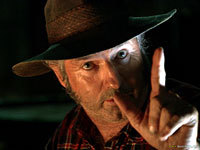
- The casting is horror films is VITAL. I have realised this from looking at different films. It's vital because people must look the part to make the film really scary. The victim must look vulnerable, and an easy target to make the audience believe that they are the victim and the feelings they are feeling are real. The murderer must look strong but also have an eeriness about them and have an almost sinister look. For example the murderer in 'Wolf Creek' looks like a murderer. He has an odd look to him that makes you scared of him instantly. He almost looks dirty, the perfect casting for a 'baddie'.
The murderer from 'Wolf Creek'
Lighting
- Horror films usually take place in the night time when everything is a bit scarier. The darkness makes it harder for characters to pick things up, but the murderer always seems to have an advantage when it's dark as they always seem to be able to see the victim but the victim can't see them. The lighting is vital to create the scary mood/atmosphere that horror films need. A film that shows this perfectly is 'Paranormal Activity' as the ghosts only seem to come out at night.
As you can see from the time in the bottom right corner,
all the 'paranormal activity' happens at night.
We don't have the equipment to work well at night, but as this is the opening sequence, I don't think this matters too much - we will not be getting onto the truly jumpy bits and are just setting the sceneProps
- Props act in a similar way to costume, they make the film more believable. Personal props can tell you a lot about the character. For example, mobile phones, books, toys etc. In action scenes in horror films props can also help to predict what is going to happen and can contribute to the verisimilitude. It can also make the films even scarier by things they find. For example, the mask used for 'Scream' doesn't allow us to see the face of the murderer making us afraid of the unknown. Also every time we see the mask, we know there is going to be a murder.
The scary dolls in 'The Woman In Black'
add to the fear factor.
The scratched out photos create fear but also mystery.
Who done it?
Common camera angles and movements
Most horror films use a variety of different types of camera shots to make the film more interesting and dramatic. A lot of tracking shot from the side, front and back create a disorientated distressed feel as it makes us feel as if the character is lost. Many establishing shots are also used to show the location and where the action is going to happen. POV shots are used to allow the audience to feel sympathy towards the victims so that the audience can be put in their place. This creates a link between the characters and the audience building a relationship between them. This shot also allows them to feel more scared, however this shot is usual filmed from the protagonist’s perspective. Close ups of characters faces allows us to see how they react to situations and to things that have happened as it tells the audience how to feel. It also allows us to judge how the characters cope with the things happening to them and allows us to change our opinions on them. In psychological horrors many weird shots and camera angles are used to confuse the audience and make the film much wilder and deeper. Canted angles are usually used when a character has been knocked down and is slowly orientating themselves. This shows us the chaos and how that character is feeling. A great shot used in the best horror films is the shot of the murderer stabbing something or someone filmed at a low angle so that we can see the blood splattering on their face. This shot is effective as it can show the maliciousness of a person as they don't care.
We can see the anger in the characters face,
and the blood splattered on his cheek to show the aggression.
We can see the fear/shock on the girls
face when she realises what is behind her.
The utter fear and agony is portrayed on this woman's face,
making us sympathise towards her.
Camera Movements Task
TASK
Film a conversation using:
Establishing shot that zooms in
Panning shot to show character 2’s arrival
Shot / reverse shot not equal distance representing one character as less prominent / lower status
Arc shot / 360 shot – character 2’s reactions to dramatic news
Tracking shot as character 2 runs off.
Objective: to practise camera movements and evaluate technical issues around them / pros and cons for their use.
Tuesday, 20 November 2012
Chosen Genre
Researching my Chosen Genre
- I thought that looking more into horror/psychological thriller genre films would be interesting and productive to make sure that as a group we could make our final piece look very professional with the use of different elements, especially as we weren't quick to decide on our genre and considered rom-com for a while as well and so our research was more divided between two genres than some other groups. We want our film to be original but fulfil expectations of our genre.
Common camera angles and movements
- Various camera angles and movements are used to make the thriller genre more melodramatic. When looking at a variety of horror and sinister films I found that in general, there are a lot more camera movements than there would be in e.g. rom-com. This is not just the classic handheld camera while someone's running scene; I noticed that even in quiet scenes of dialogue, the shot / reverse shot technique is used with a slightly moving camera tracking round the characters, giving the sense that nothing is stable
- A common camera angle is a POV shot this is used to allow the audience to feel sympathetic towards the characters and is often an important shot when filming a horror. This shot also puts the viewers in to the character's position allowing them to feel more scared. This shot is usually filmed from the protagonist’s perspective, but there are also POV shots taken from the villain's perspective to give a sense of spying on / stalking the main character.
- For example shown in this photo; this was taken from the father perspective, allowing the audience to sympathise with him.
- There is always a sense of there being something out of view of the camera, hidden in shadows or just behind the reach of the lens. This means you can also use the camera to create a jump - suddent changes of direction etc.
- There are generally tracking shots of the characters, running or walking along side of them this is good shot in most horror to convey panic and discomfort.
- Looking at horror and psychological films another common angle is a 360 degree shot which tends to represent something significant or someone who is confused and disorientated.
- In certain films there is usually a key prop that is used to kill the victim; they normally convey that this could be an important object in the beginning of the film and allowing the audience to identify the murder object later on in the film. There is normally close ups to show the significance.
Props to be taken into consideration – Murder weapons/ papers of proof / images
- The action tends to happen at night in most horror and psychological film, when the night time comes it allows the viewers to get the sense that something is going to happen e.g. a murder. For example the film below – ‘Buffy The Vampire Slayer’

- Common lighting that is used when a murder is about to take place is usually the moon light or street lighting, allowing a more spooky effect. Overall murders or any other action that is about to take place is normally filmed in dimmer lighting. As shown above.
- In this screen shot below, a murder is about to take place, however the only lighting is provided is the moon light and street lights.
- Costume is an important factor in looking at films; this is because you can tell what character they are more likely being by their clothing. For example a mysterious man in a long coat and a hat, can usually be compared to the murder in the average horror film. However this is not always the case as the audience could be wrong from their initial thought of the character.
Costume that we need to take into consideration is:
Everyday clothing and trends
Coats and hats
Knife for mother? Or cooking that looks sinister?
Coats and hats
Knife for mother? Or cooking that looks sinister?
- The victim is usually conveyed as very vulnerable character, they tend to wear day to day clothing as shown in the screen shot above.
- The location where the action is about to take place has a wide range of locations from fields to houses etc. This is shown in the screen shot below.
We need to look for spooky houses and grave yards.
- In horror/psychological films a common editing technique is dynamic cutting and jump shots. This is to build up the tension and make the action more effective, allowing the audience to get a sense that something is going to take place.
Characters who usual appear in horror films
- There is usually a very vulnerable character that is oblivious to everything that goes on around them.
- There tends to be a close friend that is the person who is killed first or is found out to be the murderer.
- There is always that character that is portrayed to be the murderer, however this person is usually found as innocent.
- Rebel – this is someone who is normally the antagonist and usually has a counterpart. This person tends to be a troubled young adult and is seen as a confident outcast.
- A young man who is found to be very heroic.
- There is usually a romance; however this is not always the case.
- Experienced character – monster killer (tends to have plenty of weapons)
- There is almost always a survivor at the end of the film
Conventional ways of using sound
- It is commonly found that in horror films there is a use of non- diegetic music, for example a sinister like music. This helps create an effective and dramatic atmosphere before the action is about to take place in the film.
- There is always a use of enhanced sound in these types of films for example screaming, footsteps, wind blowing, rustlings etc. This adds to the tension and mystery. This is a use of ambient sounds to create mystery in some way or form.
- There is a use of dialogue in most films, to tell the audience what is going on; there is rarely a voice over. However if there is a voice over it is usually telling the audience about someone’s past or something that could of happened many of years ago.
Typical iconography of a horror/psychological film is normally victims and people with numerous weapons. There Is usually a hiding place where the victim hides and looks to for safety, however they always get found by the murderer for example ‘When a Stranger Calls’ she hide under the bed only to be found moments later.
If filmed in a forest or outside the character usually trips and falls when running away from the murder or end up injuring themselves.
If filmed in a house there is usually a lot of glass around and everything in the house is wrecked from the windows to the walls.
Subscribe to:
Posts (Atom)